AizaMD™ · SaveLife.AI™
An AI scribe designed to give physicians the visit back.
Ambient documentation that records the visit and drafts the note and codes for the physician to check and sign.

TL;DR
- Problem
- Physicians chart during the visit or at night, and won't sign an AI note they can't check fast.
- What I did
- I designed the review loop: the transcript as source of truth, a setting for how much the AI writes, and suggestions and codes that never apply themselves.
- Result
- Shipped on web, Chrome extension, iOS, and Android, with ComHub built in. The 30-second sign-off is a target, not yet measured.
Outcomes
- 4Platforms live: web, Chrome extension, iOS, and Android
- ShippedComHub messaging, designed and built with production code I wrote
- 1,000+Clinicians on the SaveLife.AI™ platform, a platform figure
Project details
- Role
- Senior Product Designer
- Team
- Ahmed Daud (me)
- Dr. Junaid Kalia, CEO and practicing physician
- SaveLife.AI™ engineers and clinical advisors
- Timeline
- 2024 to 2026
- Platforms
- Web, Chrome extension, iOS, Android
- Scope
- Note review and sign-off, AI controls, coding, error recovery, EHR schedule, ComHub
- Status
- Live with physicians on the SaveLife.AI™ platform
Problem: The Note Was Stealing the Visit

The note gets typed with eyes on a screen, or finished at night. AizaMD™ records the visit and drafts the note and codes. But the physician owns every line, so checking has to beat writing: one target, review and sign in about 30 seconds, with four questions answered.
Where did this line come from?
Answered in Decision 01
Can I choose how much the AI writes?
Answered in Decision 02
Will it change my note or codes on its own?
Answered in Decisions 03 and 04
What if the recording fails mid-visit?
Answered in Decision 05
Decisions: Designing for a 30‑Second Sign-Off
Five decisions make the draft quick to check and fix.
Constraint
AizaMD™ is a documentation-support tool. Every note, suggestion, and code is a draft until the physician reviews and signs it.
Decision 01
Fix the Source, Not the Note
- Why
- The transcript is the record of what was said. Patch the note by hand and the two drift apart.
- Result
- One fix in the transcript regenerates the whole note.
- Save & Regenerate rebuilds the note from the fixed transcript
- The visit summary is labeled Provider Reference, so nobody mistakes it for the chart
Decision 02
Let the Physician Choose How Much the AI Writes
- Why
- The AI supports and never overrides. The default, Minimal, adds formatting and small clarifications; the physician can go lower or higher.
- Result
- Three levels shipped: None, Minimal, and Extensive, each with a live example.
- The default: formatting plus small clarifications
- The riskiest level warns that it may infer details
- A live preview shows what each setting writes
Decision 03
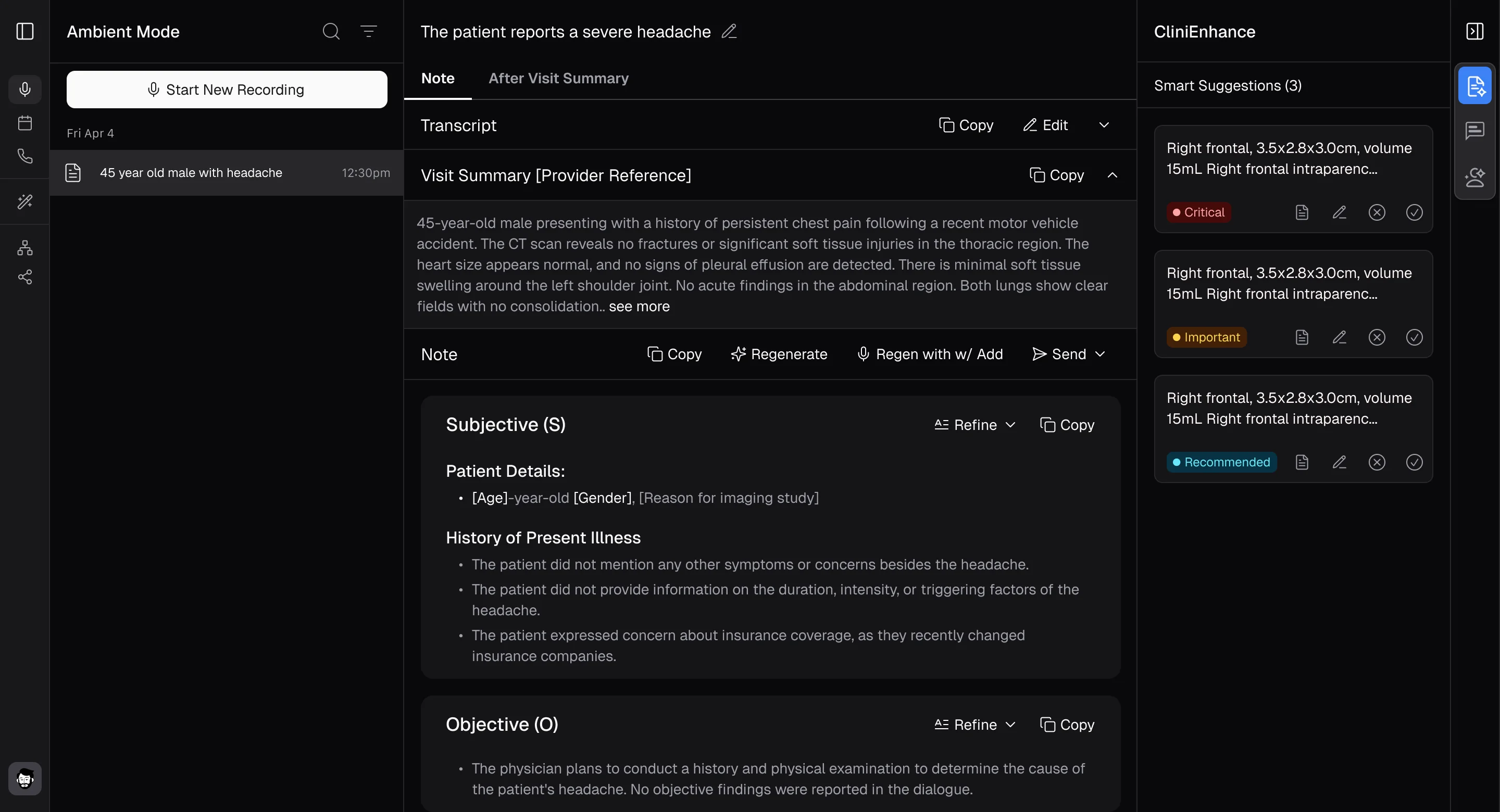
Ranked Suggestions That Wait to Be Accepted
- Why
- CliniEnhance ranks each gap Critical, Important, or Recommended, so a short review still covers what matters.
- Result
- Each suggestion shows its rationale and impact. The note changes only when the physician accepts.
Step 1: Ranked
Most urgent first, each with rationale, edit, dismiss, and accept
Step 2: Explained
Clinical and financial impact beside the accept button
Step 3: Loading
While it works, the panel says so
Step 4: All clear
With nothing to fix, it says that too
Decision 04
Codes the Physician Picks
- Why
- Codes go out under the physician's name, so each one must be easy to check and impossible to send by accident.
- Result
- ICD-10 and CPT suggestions, with a rationale for each procedural code. Only the codes the physician selects reach the EHR.
- Several candidate visit codes to choose from
- Each procedural code links to its own rationale
Decision 05
Fail Loudly, Recover Gently
- Why
- A note built on half a recording is worse than no note.
- Result
- Recording pauses when the connection drops and resumes only when the physician taps Resume Recording.
Step 1: Connection lost
Recording pauses, and the screen says it is retrying
Step 2: Back online
Nothing restarts until the physician says so
Workflow: Fitting Into the Day Physicians Already Have
A scribe outside the EHR just turns typing into copy and paste. AizaMD™ starts from the EHR schedule and sends the signed note back. Between visits, dictation works in any app.
- Every appointment shows its note status
- Vitals, insurance, and past notes one tab away
Step 1: Ready
Press F1 in any app
Step 2: Listening
Timer and live waveform while recording
Step 3: Pasted
Confirms which app got the text
ComHub: From Design to Production Code
Patient conversations shouldn't live in personal text threads. ComHub is HIPAA-compliant messaging inside AizaMD™; I designed and shipped it end to end, writing production code alongside our engineers.
- Group, case, and direct chats under one Universal Inbox
- Critical Alerts stand apart from routine messages
- The sender flags what is critical before sending
Impact: What Shipped, and What Is Still a Target
Where it stands
- Platforms
- Web, Chrome extension, iOS, Android
- EHR
- Schedule in, signed note back to the chart
- Also shipped
- ComHub messaging, production code included
- Sign-off target
- About 30 seconds, not yet measured
Reflection: What I'd Carry Forward
A setting beats an accuracy claim
Physicians can turn a setting down. An accuracy figure they can only take on faith.
Make every AI addition name itself
Labels like Provider Reference cost little and spare a full reread.
Measure the target from day one
Time ready-to-signed in the first release, so 30 seconds becomes a result.
Next Case Study
Fitcy Health · Mental Health
Fitcy Health
A first therapy session people trust enough to book.
+25% booking conversion
View Case Study


Building clinical AI? I'd like to hear about it.
I'm open to senior product design roles in healthcare and clinical AI. Email is the quickest way to reach me.
Or write to theedaud@gmail.com