The first AI radiology reading engine to ship at clinical scale.
An AI co-pilot for radiologists that turns DICOM scans into structured reports. Deployed across the US, Qatar, and UAE.

Role
Senior Product Designer
Timeline
May 2024 to Present
Reports Generated
1M+
Role
Senior Product Designer, sole designer on the product
Timeline
May 2024 to Present
Team
Ahmed (me)
Dr. Junaid Kalia (CEO, physician)
3 engineers
An AI Co-Pilot for the Reading Room
A radiologist reads a study, dictates a report, signs it, and moves on. They do this dozens of times a day, sometimes past a hundred. The reading is the skilled part. Everything around it is overhead, and that overhead is what stretches an eight-hour shift into another two at home.
RadioView.AI™ is the imaging platform at SaveLife.AI™. It takes a DICOM scan, drafts a structured report, and hands it back to the radiologist to review and sign. I owned design as the sole designer, working with the CEO, a practicing physician, and three engineers. This case study is about what it took to make an AI draft something a radiologist would put their name on.
The Problem
Radiology runs on tools that were never built to talk to each other. The scan is in the PACS, the report is dictated into a second system, the history sits in the EHR, and the case that cannot wait is buried in a worklist of eighty. The radiologist is the integration layer, holding it together by switching tabs.
Hours of every shift lost to dictation and cleanup
Four tools, one screen, constant context switching
The urgent case buried in a long worklist
Hospitals will not rip out the PACS they already own
What Radiologists Told Me
Before picking a direction, I interviewed more than seven radiologists across our early sites. I expected to hear about speed. I heard about trust. The same three worries came up almost every time: they would not replace the PACS they owned, they would not sign a report they could not verify, and most had been burned by an AI tool that sounded confident and got it wrong.
I am not putting my name on a paragraph I did not write and cannot check. If I have to re-read all of it anyway, the AI has not saved me anything.
Radiologist, early partner site
Those three worries became the brief. Every decision that followed was an answer to one of them.
Designing for Trust, Not Just Speed
Generating a report was never the hard part. The model could do that. The hard part was earning enough trust that a radiologist would rely on the draft under pressure, and staying out of the way on the cases where minutes change the outcome.
Decision 1: Sit Beside the PACS, Don't Replace It
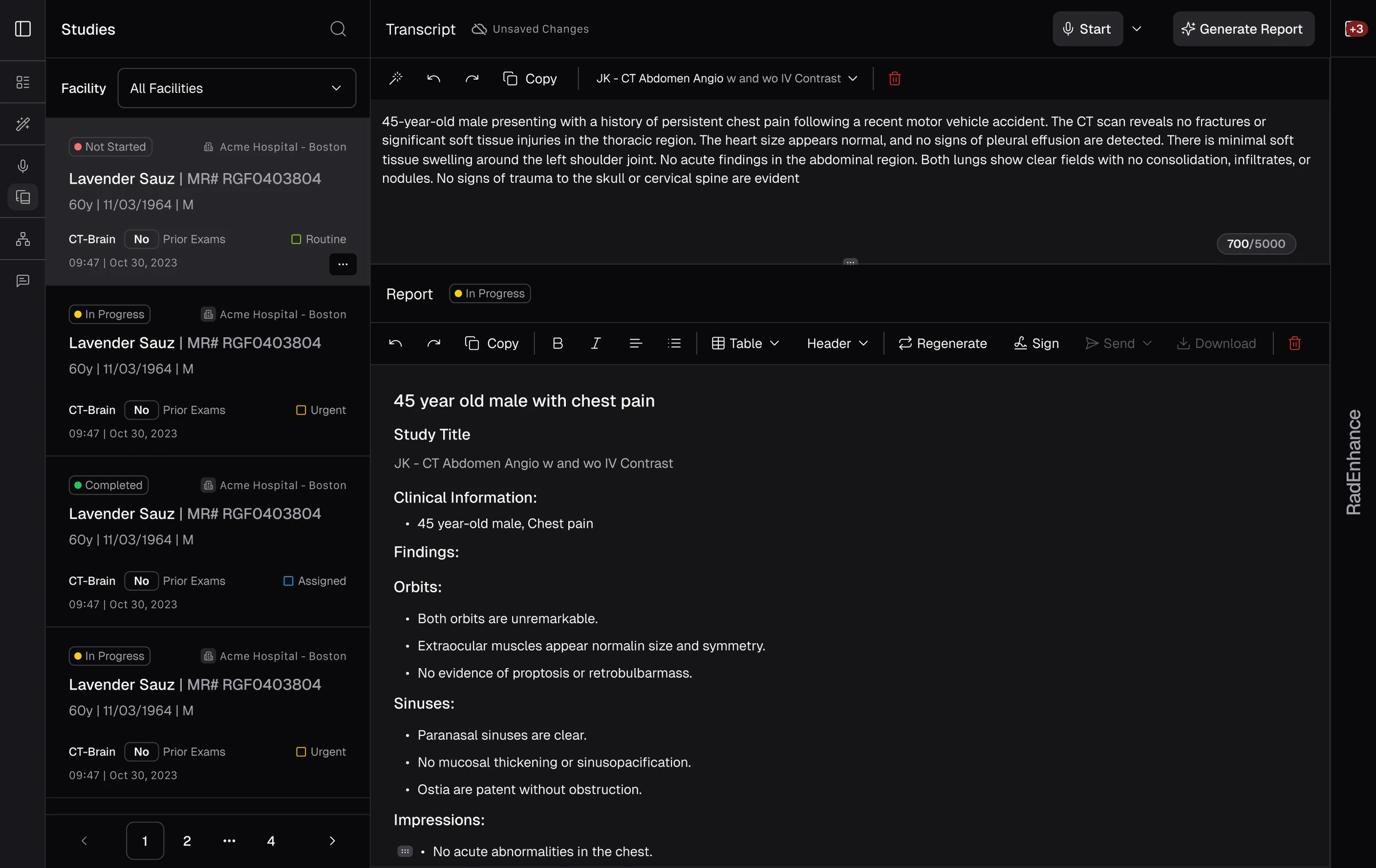
The obvious product is a full replacement. Every hospital I spoke to closed that door on the first call: the PACS is bought, integrated, and trusted, and nobody migrates it for an AI feature. So Companion Mode runs beside the viewer they already use. Worklist, transcript, and report sit in one panel, each case flagged by status and priority, while the imaging stays in their system. A smaller surface, and a far easier yes.
Decision 2: A Draft to Review, Never an Answer to Trust
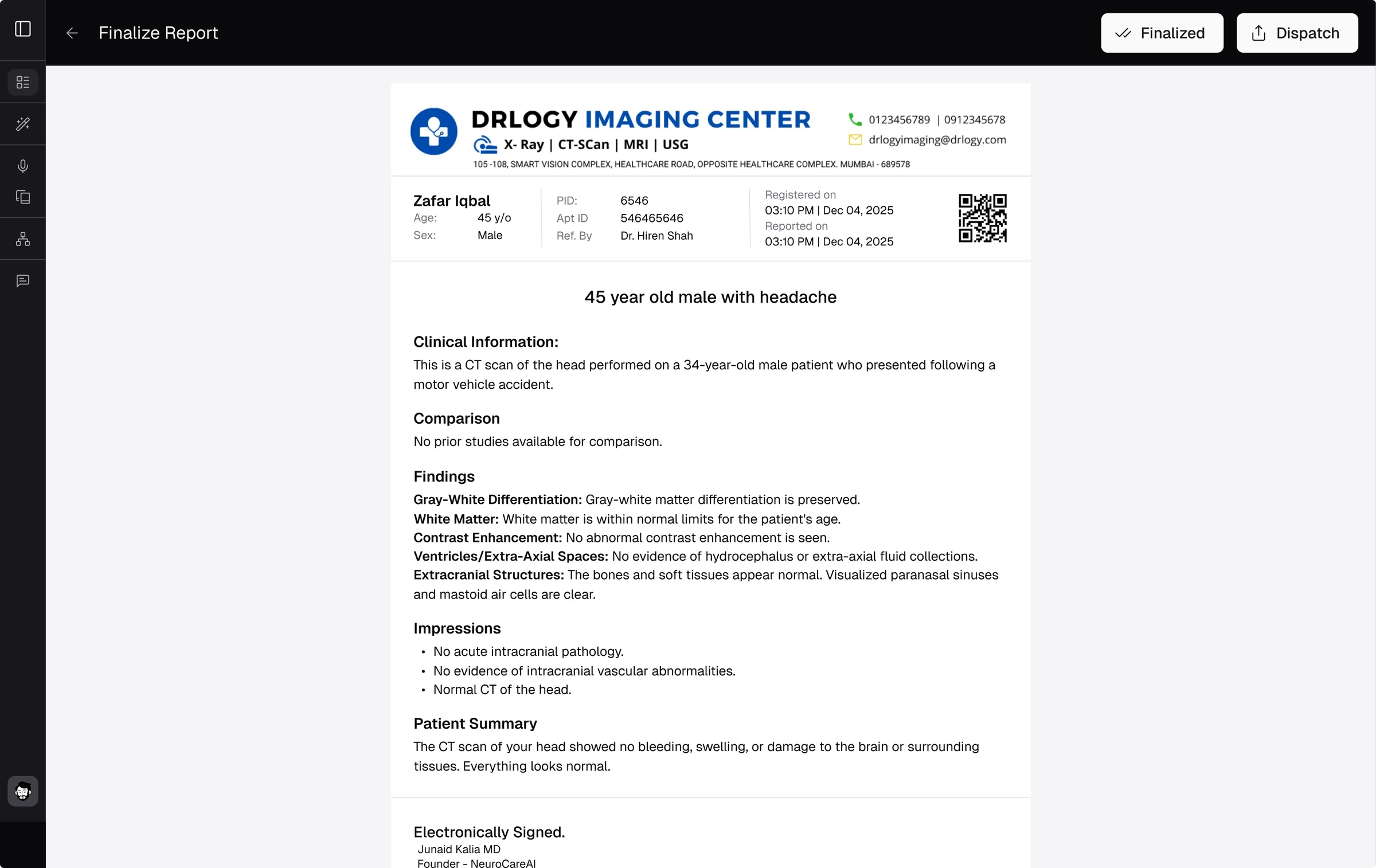
The radiologist signs the report. Their name, their license, their liability. An AI that hands over a finished answer puts them in a corner: rubber-stamp it and own the miss, or re-read everything and save nothing. So the report is a draft, not a verdict, and the radiologist moves through it in three steps.
First, they speak the read. Transcription runs in real time and is honest about its own latency instead of faking an instant result.
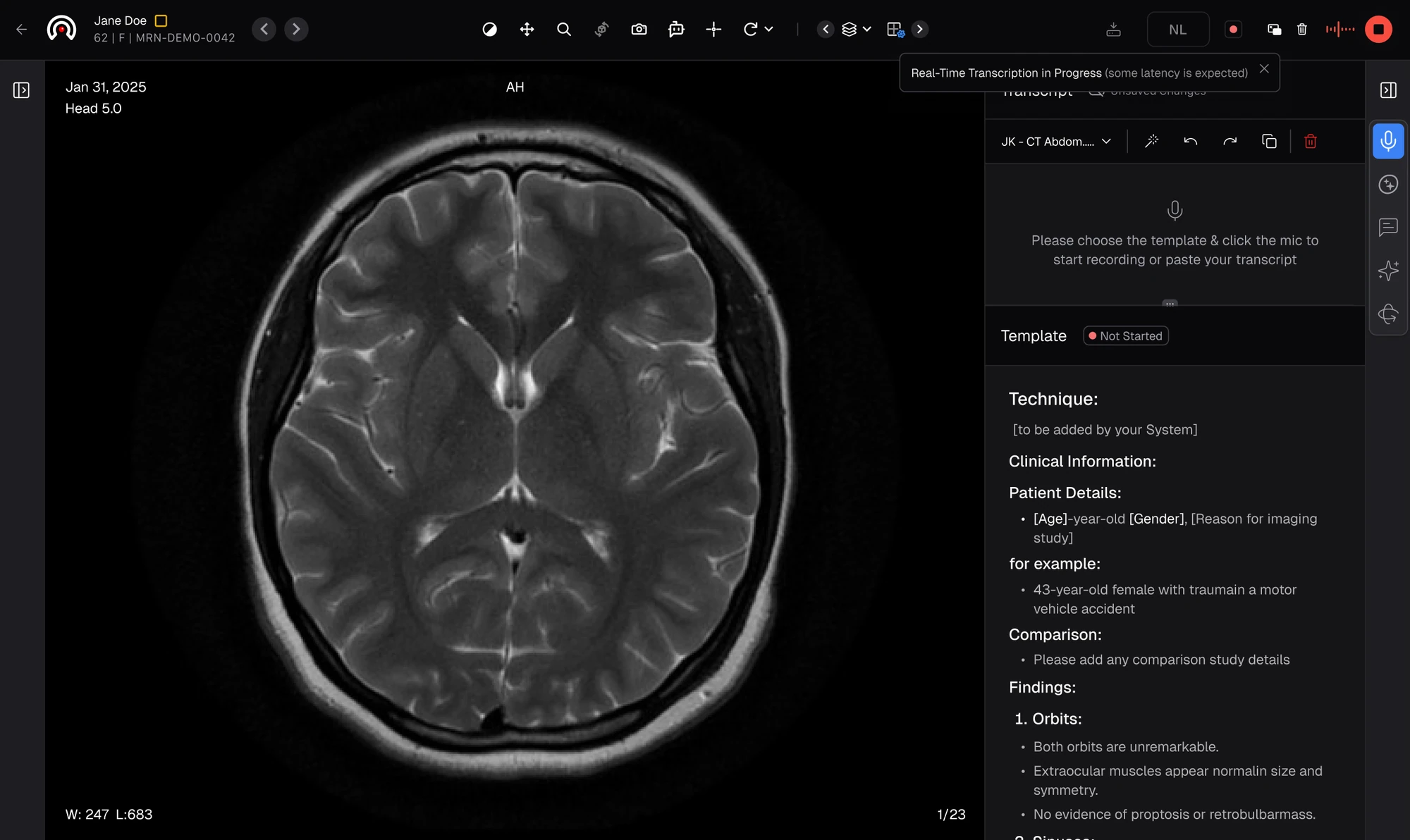
Then they refine. Every AI action is reversible, so when the system cleans up a transcript it says so and offers an Undo. The radiologist is never guessing what changed.
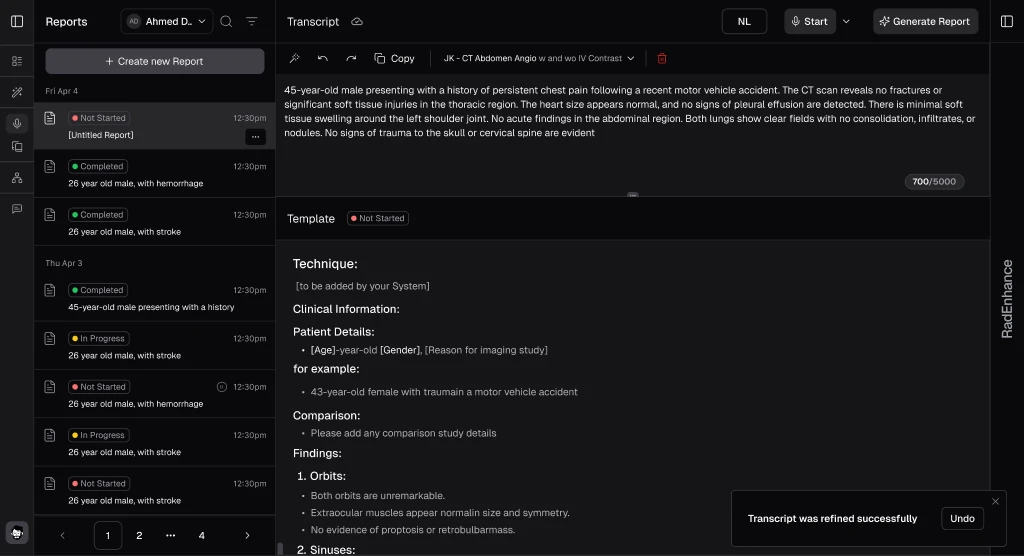
Finally, they sign. The draft is written for two readers: findings in clinical language for the record, and a plain-language summary beneath them for the patient. Once signed, it dispatches to the EHR without leaving the panel.
Decision 3: Show the Work on Every Measurement
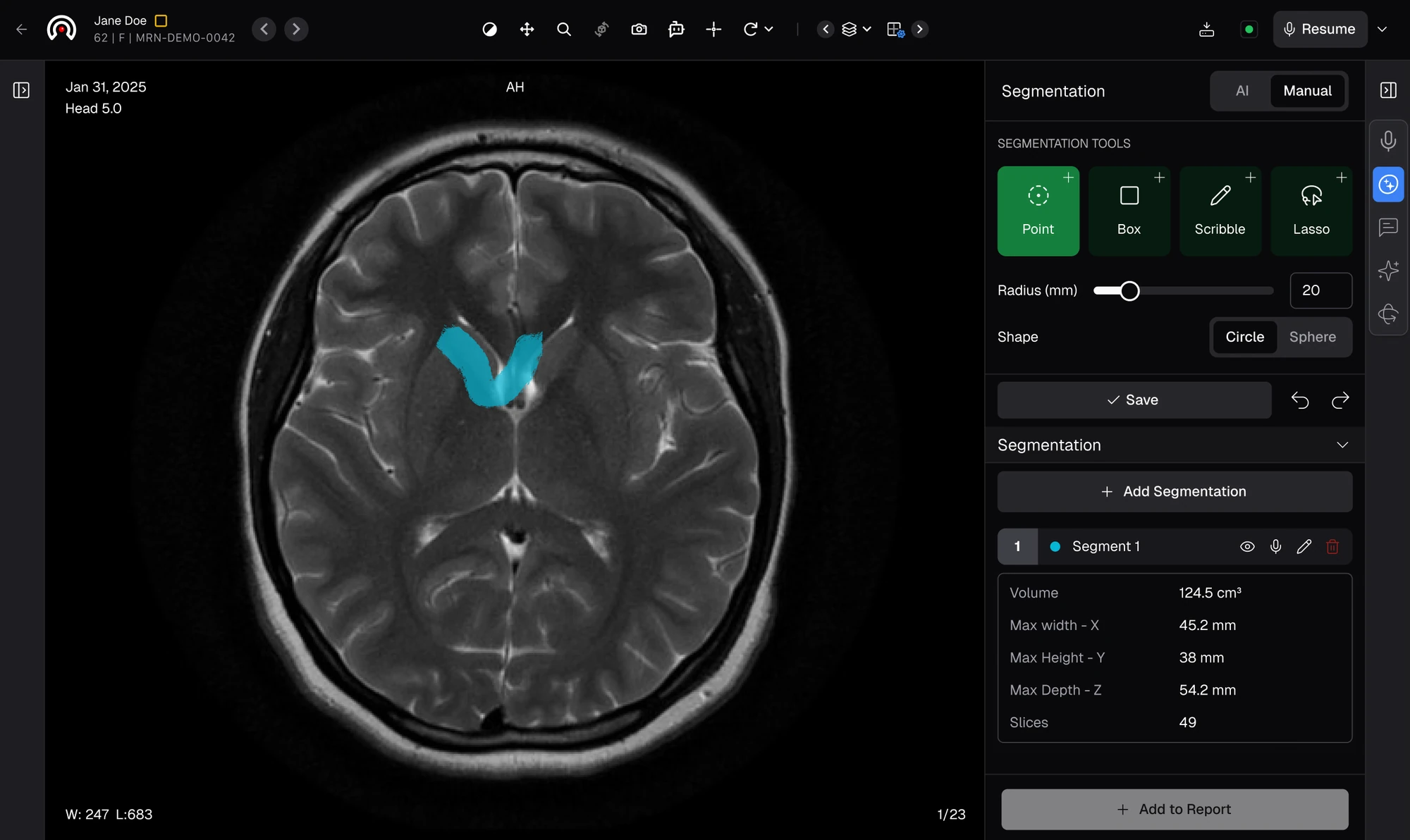
A number with no visible basis gets re-measured by hand every time, which is slower than having no number at all. So segmentation is visible and editable on the image. An AI and Manual toggle decides who is in control, and the computed values sit beside the region they describe, entering the report only when the radiologist adds them. Verifying takes a glance, not a redo.
Decision 4: Let Them Ask the Scan Questions
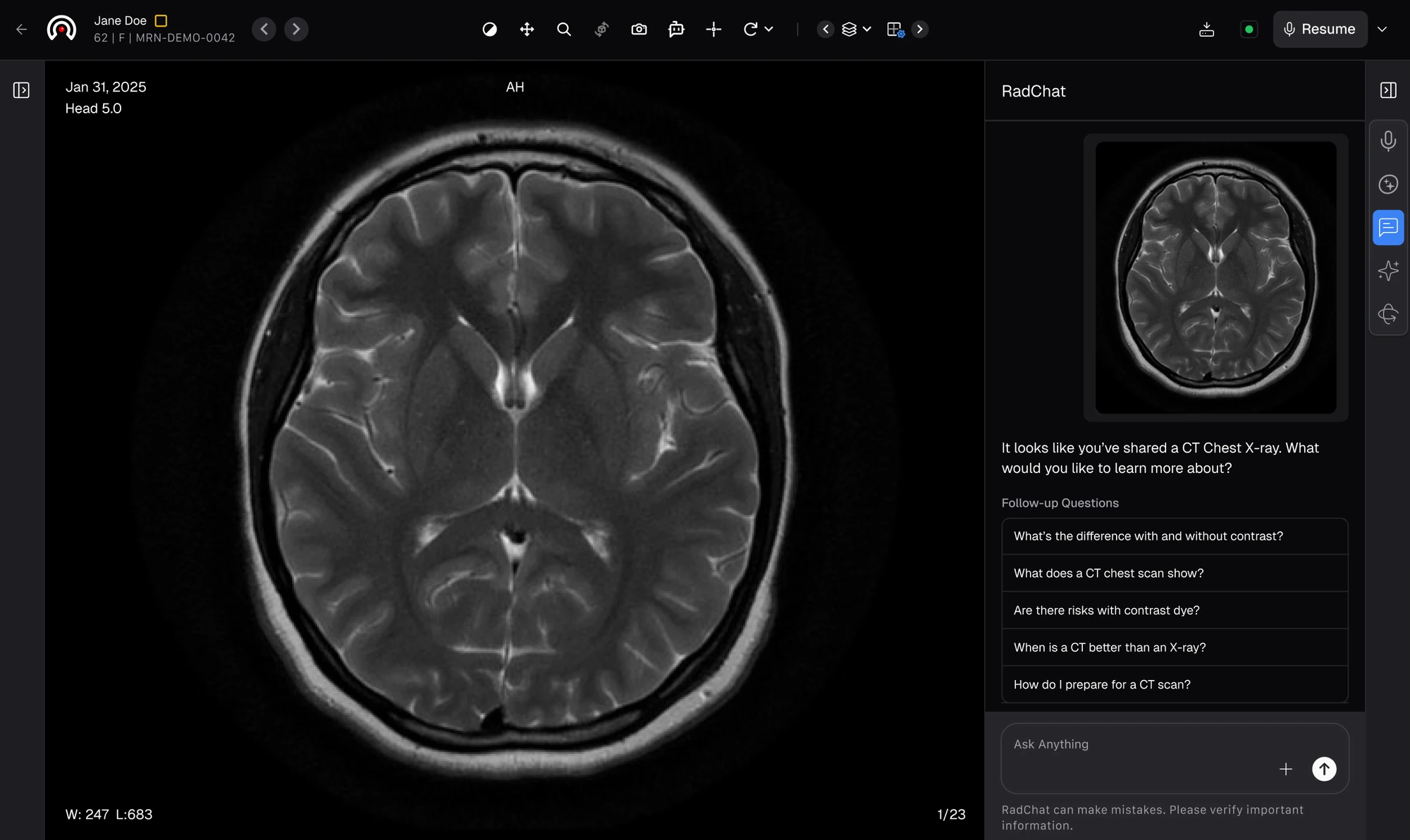
Reviewing a draft raises questions a static report cannot answer. RadChat takes follow-ups in plain language, grounded in the study and the patient history, so the answer stays with the case instead of sending the radiologist to another tab.
NeuroICH: Closing the Alert-to-Action Gap
Most imaging AI fires an alert and stops there. But the minutes between the flag and the treatment are where a stroke outcome is decided, and an alert that only blinks on a screen does not move them.
NeuroICH detects intracranial hemorrhage on a non-contrast head CT in under 60 seconds, with 97.5% sensitivity and 90.3% accuracy, and earned FDA 510(k) clearance (K241719) in 2024. The design work was the handoff: surfacing the critical case at the top of the worklist and getting the right person to the right scan before the window closes.
We made NeuroICH free across low and middle-income countries, where a radiologist can be hours away and the alert is often the only specialist in the room.
Outcomes
1M+
Reports generated on the platform
1,000+
Clinicians using RadioView.AI™
87%
Faster reporting across the platform
RadioView is live at a US hospital partner, with a 98.5% reduction in reporting time, and at Hearts Medical Solutions in Qatar as the exclusive AI imaging partner for the GCC region. Physicians across the US, Qatar, and UAE read on it every day.
The number I keep coming back to is not the speed. It is that radiologists sign the drafts. That only happens when the interface makes the AI easy to check and easy to correct, and never claims to be more certain than it is. Designing for that trust, and not just for the time saved, is the part of this work I am proudest of.
Next Case Study
Fitcy Health
Fitcy Health
Mental health care that starts with the right match. Booking up 25%, retention up 10%.
+25% booking conversion